
Leader Workaholism: The Compulsion Your System Rewards (And the Organization It's Damaging)

There is only one known benefit to a leader’s workaholism: career success.
The trade-off, though, is not worth it.
But first, use of the em dash reflects my enduring love for the thing after years in feature writing and journalism not AI. 😉
Research nicely summarized by Julian Barling, Ph.D., and Simon Rego, PsyD[1]. Consistently shows that workaholism leads to:
wrecked personal, mental, and physical health,
lower job satisfaction,
strained personal and professional relationships,
increased risk of burnout, and
damage to the workplace climate and culture.
Let’s double-click on that last one, because first, what the hell is “workplace climate?” Second, how is it different from work culture? Third, how does one person’s tendency to overwork impact an entire “climate”?
I’ll pause first to say, yes, solutions are coming. But if we jump to solutions and actions— as leaders are prone to do— we risk treating symptoms and correlations, not the root problem.
To truly solve a problem, you have to truly understand it. And in this case, we have to start by answering a lingering question you probably still have: why should I care if a leader or two is a “workaholic”? I need workers who want to work, who push themselves, who go the extra mile.
Yes, you do. But not in this way. It will cost you more than you want to lose.
Workplace Climate and Culture
The simplest way to define both and note their differences is:
Workplace climate is the vibe at work. The energy in the room (literally or figuratively for those who are remote).
Workplace culture is beliefs, values, behavioral norms, routines, traditions, sense-making, and some add the policies and procedures reinforcing these that permeate the organization.
The climate is how the culture makes people feel. It’s the source of the energy, the thing behind the vibe.
The two are interrelated. The climate can change more quickly than the culture, though the culture influences how people interpret daily experiences at work, which impacts the climate, which, over time, feeds back into the culture.
This distinction comes primarily from the work of organizational change and culture pioneer Edgar Schein.
A Workaholic Leader’s Impact
What is a workaholic, exactly?
A leader’s workaholism first shows up as part of the workplace climate. Their mood, habits, expectations for themselves and others— stated or inferred by their behavior— will impact the “vibe,” what it feels like to be at work that day.
Over time, if the workaholism is consistently modeled and rewarded, the workaholism becomes part of the culture. It’s the way things are expected to be done if one wants to move up in the organization.
This is where it’s critical to distinguish between a hard worker and a workaholic.
In a December article, I wrote that: “A workaholic is someone who feels an uncontrollable urge to work, often sacrificing personal time, relationships, and even health in the process. On the flip side, an engaged worker is passionate about their job but knows how to maintain a healthy balance between their personal and professional worlds. They can disconnect and recharge, which ultimately makes them more effective.”
Like so many things in life, the intention or drive behind the action matters.
Two workers could be working consecutive 12-hour days and holding themselves to high standards. On the surface, the two workers look the same. Beneath the surface, however, one is driven by a regulatory deadline and pride of authorship.
The other is driven by a belief that their worth is wrapped up in long hours, and constant busyness. And/or the need to feel safe, and in this case the constant work feels safe because slowing down can trigger discomfort, such as fear of irrelevance, loss of status, fear of looking lazy, loss of control, being raised with the requirement to finish all your work before you can play, and even the fear of feeling the feelings that have been stuffed down in order to grind on.
True workaholism is about compulsion. Workaholism is not just about long hours, high standards, drive, ambition, or passion. Those can be part of the workaholic experience, but they, in and of themselves, do not make someone a workaholic.
I wrote about the difference between an engaged worker and a workaholic here. You can also read Schaufeli and his co-authors’ academic research discussing the differences here.
A workaholic leader’s impact
A workaholic leader changes how work gets done and how well. It changes the vibe and, over time, the culture.
For example:
Over-involved leader → under-functioning team because leaders are undermining autonomy through micromanaging, eroding trust, and initiative, so they escalate decisions and underdevelop their ability to problem-solve.
Leader urgency → chronic reactivity culture reflects reactions to crises, teaching that short-term firefighting is the norm.
Leader perfectionism → decision bottlenecks shows that leaders measure and praise perfection as the goal, creating assumptions that "perfect" trumps timeliness.
Leader availability → blurred boundaries for everyone, teaching that constant availability is how work gets done here.
Leader anxiety and pressure → shortened time horizons, the emotional tone from the leader (fear, urgency, anxiety, stress) shapes shared feelings which impact interpersonal relations and work products, normalizing emotional reactivity over strategic thinking.
A leader’s own vibe, if you will, drives the vibe of the organization. A leader’s actions and decision-making style shape the culture through patterned behaviors that become entrenched assumptions about how work is done. What looks like dedication at the top can quietly erode capability across the organization.
Over time, the organization becomes dependent on “heroic” effort and constant firefighting rather than sound design.
Worse, research shows that leader workaholism leads to increased:
bullying,
employee burnout
gossiping, and
mental & physical health strains
and decreased:
employee job satisfaction,
organizational citizenship behaviors, and
performance
Leader workaholism is an expensive problem, including the cost of the raise that accompanied the leader's promotion— because you rewarded what looked like dedication, remember?
So why do they keep getting promoted?
Well, I just gave away one possible reason, that what appears to be healthy dedication and engagement, is workaholism. You don’t know that, so you reward what you think you see.
One reason you don’t know whether it’s engagement or workaholism could be that you are moving so quickly through your own to-dos that you haven’t really connected with or coached this particular leader. This is a common issue at all levels of organizations. People move too fast to know each other, the ripples of which include, but are not limited to, not being able to see what’s really driving behavior in the workplace.
Another reason could be that colleagues know there is an issue, but don’t know how to step in. Another possibility is that some of the effects are downstream enough to make it hard to trace them to the root cause without an objective outsider’s help, both because the situation is complex and because CEOs/founders/managing partners are often pulled in too many directions and moving too quickly to do so. Here again is that moving too quickly problem.
I think the biggest drivers, though, come back to systems and identity. Put another way, the mine and the canary.
In this case, your workplace and society are the mine, and the leader is the canary.
Even as the CEO, you don’t have much control over the canary, that is, how that individual sees themselves or measures their self-worth. As the CEO, you do have control over the system you have built.
Taking action to fix the system and support the individual will help the situation.
Here’s a simple way to think through this and get started. Ah, now we come to those much-desired solutions!
The Reward Disconnect
One place to start is with your rewards and recognition program.
Ideally, you would recognize leaders who drive outcomes opposite those listed above. So why aren’t you? (Because you were raised, most likely, in the same societal mine that encourages overwork and celebrates lack of sleep etc....just a thought…?)
Many firms say they value collaboration, work/life balance or “wellness” or “well-being”, and want people to use their vacation days, etc. But leaders don’t role-model it, and rewards and recognition programs, as well as daily social exchanges, reward rapid responsiveness, long hours, and visible busyness.
If you reward urgency, you normalize reactivity.
If you reward overextension, you institutionalize burnout.
If you reward individual output above all else, you weaken team development.
Remember, “Every system is perfectly designed to get the result that it does.” ~W. Edwards Deming
👉ASK YOURSELF: What in our system needs a redesign?
It doesn’t matter if people know that overwork is unhealthy; if your systems celebrate it, they will continue to do it.
And here's the thing: you can't redesign this alone.
If you, say the CEO, stop rewarding overwork but your CFO still praises the team that worked the weekend, or your COO schedules 7 am meetings, or your mid-level team celebrates the 'hero' who responded at midnight, the mixed messages kill the change. Your executive team must be aligned on what you're rewarding and why, at every level of the organization.
Once you do that, the problem is solved, right? Not so fast.
“Fixing” Behavior
Remember, the difference between dedication and workaholism is internal.
You don’t have to dissect your workers’ inner thoughts and childhood experiences or something— in fact don’t.
But you can pay attention, deep attention to their behaviors and the impact the behaviors have on those who work with and for them.
For example, does the COO take time off or not? If they do, are they still working during that time off?
Does the COO consistently engage in late-night/early-morning emails or availability that isn’t tied to specific deadlines or crises?
Do they work sick and/or skip family obligations consistently for work?
Do they delegate and say no to low-value tasks, or do they do it all?
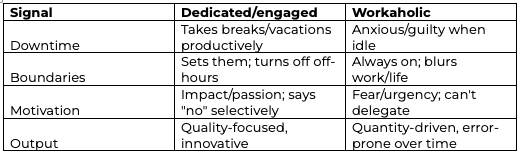
Engaged (or dedicated) leaders prioritize recovery; workaholics rarely disconnect fully. Engaged leaders set boundaries; workaholics can’t turn off. Engaged leaders empower teams; workaholics struggle with letting go.
Team patterns stemming from workaholic leaders include high turnover, signs of burnout, and dependency. Below is a table to help guide you.
To take action, you can:
1) Ensure that you have an EAP program, that use of the EAP program is normalized, not stigmatized, that all employees know about the program, and know how to use the program.
Work with your HR/Benefits team to push out messaging around the use of the program. And have the rest of the senior leadership team, including the COO, familiarize themselves with the program and reasons one might use it, such as workaholism. Ask them to push the HR/Benefits messaging through to their staff.
This might at least plant seeds for the COO to act on when ready.
2) You can use pulse checks and work audits to identify cultural factors that are reinforcing the behavior. One place to start, though, is with your rewards/recognition programs.
What values are on the wall, literally and/or figuratively? Are they aspirational or operational? Look at all levels of the organization.
Have you created a work environment that makes it safe for people to ask for help, such as help prioritizing tasks, coverage during vacation, or guidance on navigating the EAP program?
Are employees at every level encouraged and rewarded for role modeling healthy work practices or for being the late-night/weekend hero?
Rewarding the former does not mean lowering standards or missing deadlines. There will always be times when people need to push. However, to push, they must recover after sprinting uphill. Otherwise, they won’t make it up the next hill.
Lastly, if you want your workaholic leaders to get help, you have to make absolutely clear that they are not at risk of losing their position or status for dialing back the hours or reducing their busyness. This ties directly back to what you are rewarding via bonuses, promotions, and praise.
If you’d like guidance at the organizational level or as an individual rather than white-knuckling this, schedule a complimentary consultation here.
[1] Julian Barling and Simon A. Rego, The Cognitive Behavioral Therapy Workbook for Leaders: How Improving Your Mental Health Is Essential to Avoiding Burnout and Leading More Effectively (Oakland, CA: New Harbinger Publications, 2026).